Showing posts with label Fun. Show all posts

Tuesday, 15 September 2020

Talking Millennial Discontent, Sexism in the Workplace, Aggretsuko and Being the Golden Turd, with Ben Diskin


Ben Diskin Interview


Ben Diskin is the kinda guy who has managed to stay under the radar for years, often playing some of your childhood’s most beloved characters without you even knowing. To paraphrase a writer better than I, you may not have heard of Diskin – but you have definitely heard him. With leading roles in everything from Kingdom Hearts to JoJo’s Bizarre Adventure, Ben has amassed a plethora of unique credits that have won hearts across multiple fandoms.

Yet, all of this is a far cry from what was one of his first (and still one of his most famous) roles, as Sylvester in Kindergarten Cop, alongside with Arnold Schwarzenegger – a job he is inevitably quizzed on regularly, despite the film being 30 years old. I, of course, am no different – and begin my questions by inquiring as to how it feels to have had this start, in his acting career.

“I had very realistic expectations set for me by my parents, who are both actors, so they put me forward with the idea that this would get me a little bit of money that I could put toward college, so I could get a real job”, Ben tells me. Luckily for us, however, this was only the beginnings of Ben’s career, as he quickly moved on to voice acting over on-camera acting, when his agency began putting him forward for VO jobs.

Being around 6 at the time, Diskin couldn’t quite read at that age – but was more than adept at repeating phrases back to the crew, on request.  “The voice-over and on-camera work came about at the same time” he explains, “When you’re a child actor, and you can moderately take direction reasonably well, they put you in everything!”.

As I soon learn, however, he immediately goes par for the course, in terms of his modesty, by becoming incredibly self-deprecating. “Compared to kids nowadays, I was garbage – but back then, I became the Golden Turd! Which is going to be the name of my autobiography, one day”, he jokes. That said, there is no doubt that this was the career Ben was truly made for, both as a guy with the ability to create a vast range of characters, professionally, and in terms of his personal preference. Particularly as he can be quite averse to the level of fame that comes with on-screen work.

“Back then I was a stupid little kid and I went and told all of the kids on the playground about how I was going to be in a big movie – and I thought it was really neat! But kids don’t really have a concept of fame or money, so everyone thought I was a millionaire movie star… and started treating me like crap” he explains, “but when you do voice over, you realise that so many people love your characters without associating you with that character”.

Clearly, this is something that has stayed with him to this day, as he tells me how he loves the voice over world for giving him the ability to play and create new characters, without the hassles of fame that inevitably come when people consistently recognise your face.

“It’s really kinda nice that I have some control over whether I tell people if I’m on a show!” Ben laughs – but there’s a sincerity to his viewpoint that, even now, comes across in how he interacts with his fans. He admits to me that there are times at cons when he spends as much of his downtime as possible in his hotel room, in order to avoid near-constant over-stimulation through interaction with fans. Although it is worth noting that, like the rest of us, he can sometimes be found meandering through con halls because he’s feeling a little lonely – so, if you do happen to catch him at a con, he’s likely to welcome a quick chat.

Imposter syndrome runs deep within Ben’s personality, which is often exhibited through his sarcasm, dark humour and, in his own words, “naturally pile-driving myself further and further into the dirt – that’s my instinct!”. Referring to his award-winning work on Muppet Babies, he tells me “I have an Emmy on the mantel… and I’m still convinced someone is going to come in and take that back, any minute now”.

So, how does he battle his own inner demons, when faced with a tough role or a bad day? “With a heavy dose of reality!” he laughs, “I tell myself that I’ve been doing this for long enough, that I’ve been consistently working for years – I don’t let myself get a big head, but being positive about my work is my best coping mechanism”. That’s not to say he doesn’t struggle when something new comes along – namely singing. As it turns out, Ben isn’t too keen on singing or dancing, although he used to be able to carry a tune on the clarinet (in case you were wondering).

Throughout his career, which now spans three decades, there has only ever been one time where work – of lack thereof - became a huge point of stress for him. Having just bought a house in the late 00’s, his career took a downward turn and the ability to pay the mortgage was quickly shrinking. Like all successful actors, however, the answer to this problem lay in working even harder, for what felt like minimal payoff, until – one day – his career picked up again. “I was desperate and did the only thing I could, which was to knuckle down and take any work I could get” Ben confesses, “which is lucky – because I don’t have anything else I can fall back on!”

If anything, this tough period has helped Ben to gain more clarity on how to go about getting work, from auditioning to working on each, individual project in its own, individual way. “It always depends on what kind of thing you’re going to be working on” Ben clarifies, when I ask him how he approaches a new role, before going on to display a wide range of different pitches and voices, in order to explain each genre.

Of course, even within the same genre, there can be different styles, he explains. “A Shonen style anime will be very different to more realistic, grounded work from Japan, so each show needs to be performed according to the style they’re going for”.

Then there are the personalities themselves, which inevitably drive the character forward within the series, film or game. He reminisces particularly on one villain he played, after which he had to field questions at a con about his character “I was asked how I prepared myself for this villain – everyone else was talking about how they related to their characters and how they could draw from their own experiences. I just had to say ‘errr I don’t know! I was just acting!’ - So, yeah, sometimes it’s just fun to do something completely different to myself. To just act.”

Ben goes on to reveal the audition process he had for Haida, in Aggretsuko, in which he construed the character to be somewhat of a lady’s man. As it turns out – and as fans of the series will already know – that’s not quite how things pan out for the humble hyena. It’s all part of the process, however, and the casting/voice directors worked with him to give us the personality we all know and love, now.

Another major benefit to being in the industry from a young age comes with seeing all the changes in the industry – for better or worse. At this point, I can’t help but ask him how things have changed in Hollywood, when it comes to getting roles. “Well, when I first started out, all the auditions were on tape – and, if you screwed up, they would literally have to stop and cut the tape” he recalls, “now, however, I can send over auditions from home and send those over as an mp3. If you’ve got a good mic and good set-up, then that opens up doors to a lot of new talent.”

Most recently, his work on Aggretsuko has him playing the role of Haida, for which season 3 was recorded entirely from home. And, while playing animals with human-like characteristics isn’t exactly a new venture in animation, the release of Haida into the Netflix universe also coincided with another character who came about at around the same time – namely, Beastars’ Jack, whom he also voices.

With so many anthropomorphic creatures coming out at once, it was only a matter of time before our dear Ben caught the eye of the furry community. Naturally, this makes my interviewee a big point of fascination for these anthropomorphic enthusiasts, and you can often find Ben discussing the community, his stance and the fanart of these characters over on his Twitter account.

Being completely new to this culture and fandom myself, Ben is kind enough to discuss with me what it means to be a part of something like that. “I discovered them through working on Aggretsuko,” he tells me, “and I’m a huge fan of the show myself. Which, usually, when I like a show, it means nobody else is interested – cause that’s just how it goes for me. I naturally gravitated toward the character that I played and kinda fell into it. But it means I get to act like a giant idiot fanboy online with everyone – and it helps the show!”


Of course, Haida himself resonates well with followers, making him a big focal point for fanart and fictional crushes within the fandom. When I ask Ben why he thinks Haida is so popular, his answer pulls the full gamut. “The show is filled with strong female characters, with most of the guys either being horribly sexist or just shouting at Retsuko” he reminds me, making reference to season 1 characters, including the yoga instructor and her boss, “so, when you see a guy who is actually cute and nice that makes it easy to relate to him. But I think it also stems from being the guy who has the crush, that doesn’t get with the person he likes, and his feelings are unrequited. So, especially for people who are gay, or are furries, Haida’s experiences are so easy to relate to, because it’s much harder to find the right person when you’re in those communities.”

Despite this, Haida himself has come under fire somewhat, with mixed reviews from audiences, who seem to be divided as to whether his reactions in the season finale are appropriate, given what happens over the course of the series. This is something that Ben himself struggled with, as he explains to me, “when they gave me the clip to work with, the cover clip of the file was Retsuko crying, and I was literally pointing at the screen, saying to my wife ‘how can I make her cry? I don’t wanna do this!’”. So, just how much of Haida stems from Ben himself? “Haida is literally me from before I met my wife,” he laughs, “This total idiot, who sucks with women and pines after women who have no interest in me. I mean, if I could go back in time and slap the crap out of myself, I would!”

Through it all, there’s no denying that this is a series that is almost tailor-made for the disillusioned generation of millennials, with the main character struggling with trying to make a living in the current economy, especially in season 3. And one of the things that seems to have caused conflict with fans, is that Retsuko doesn’t quite get the traditional happy-ever-after that people expect from happy-go-lucky stories about cute animals. As it turns out, this is one of the things that Ben likes the most about Aggretsuko, because “it doesn’t point to Hollywood or fame as being the solution. It displays real-world problems and gives realistic solutions. That’s not always reality – most people do just work in the office and the show gives fans ways to cope with those moments, like her annoying co-workers and her boss”.

Interestingly, given the current news surrounding sexism in the workplace – particularly in the gaming and voice-over areas – the way that Retsuko is able to work with her misogynistic boss (as well as the advice she gets her friends in leadership roles) seems oddly well-timed, for those new to the series. We also see massively inappropriate and damaging behaviour from fans within the show, in the lead-up to the climax of the third season, which is sadly true to real life at times. And this is something that Ben openly discusses with me, when it comes to how he feels we can change things in the real world. “The biggest thing for me is to be able to call out that behaviour, when it happens”, he replies, when I ask him how we can help to stomp out that behaviour in all areas of life. “It’s not always the easiest thing – but seeing not only the way my colleagues are treated, even by fans, not only are the acts and the things that happen scary, but the way women talk about these experiences. It’s become so ingrained into our way of life, that they talk about it as though it were an everyday experience and not something terrifying – which is absolutely is.”

Taking an uncharacteristically sombre tone, Ben then goes on to point out “it isn’t always that obvious thing, the way Ton will come across in the show. It can be something as simple as phrasing something in a way that is overly familiar or those tiny microaggressions. You don’t have to make a big thing about it, or a Twitter call-out, you can just say something as and when it happens to challenge them. Just be respectful to everyone”.

And therein lies the main takeaway I can pull from my short time with Ben Diskin, in that this is a guy who is – to his very core – a genuinely good guy, who wants to bring everything he can to each role. Whether he’s creating a caricature of a voice, in order to meet the requirements of an over-the-top animation, or speaking with his followers on social media, you can be sure that Ben has plenty of love to give to his career and his fans. Personally, I can’t wait to see what else he has in store for us.

Monday, 20 April 2020

Control Review


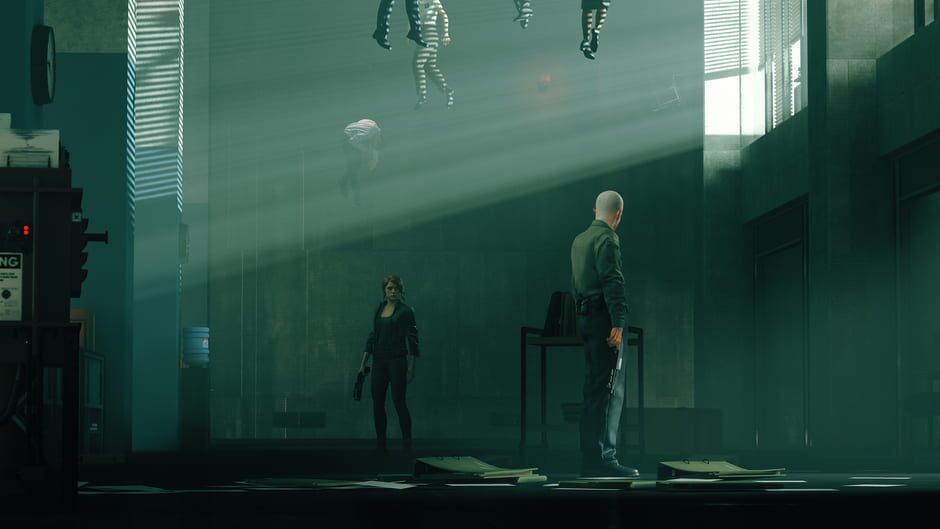
I'm a huge fan of action-adventure games, being shamelessly fond of third-person perspectives and a strong storyline. So, when I was recommended Control, I couldn't wait to get my teeth stuck into a new world - it had everything I could possibly want in a game, especially when it came to the consistently high ratings from the usual publications, IGN, Gamesradar and so on. Even better, it was recently on offer on the PSN store, something we could all do with during isolation - so I decided to delve into Jesse Faden's world for the first time. 


It begins with a rather depressing monologue that sets us up for the neo-noir theme throughout the game, and quickly leads to you becoming the Janitor's assistant and the new director of the Federal Bureau of Control. Aptly named, considering everything in this company appears to be very specific and very rigid in this game - from the brutalism of the building's architecture to the inflexible personalities. Even the interactions between the main character and the NPC's is dry at best, with the warmest character arguably being Emily Pope, whose fast-talking rhetoric can quickly give you a headache if you don't keep up. 

The house, of course, moves seemingly of its own volition, twisting and turning through different dimensions as you explore. And the novelty of this can wear off quickly, if you don't make use of the in-game map that takes up the entire screen, when highlighted. Be warned that this is not a feature you should use when entering a new room, as your extra-dimensional friends - called the Hiss - will spawn at the same time. 

The frustration of constantly fighting the Hiss is highlighted by the inability to create regular checkpoints, due to the open nature of the game - and would be fine, if it weren't for the fact that you constantly need to defeat foes that you have already conquered, each time you die - with only bosses appearing to be exempt from this. In other words, if you die while trying to figure out a boss' weak points, for example, you'll need to go from the last checkpoint, back through the building and return to the fight - listening to the in-game chatter and fighting the respawning baddies, each and every time. 

Each and every, frigging, time. 

Again, without waypoints to help you decide on which direction to go, when seeking out the story, you may find yourself doing this a lot. Too much, in this humble writer's opinion. While I can see how this might add to the overall mood of the game (a lack of control - an irony I'm sure was high-fived upon, in the office) it detracts from the gameplay. 

And herein lies the problem - Control stops being fun after the first few missions. It becomes tedious and many players appear to be losing interest in the story around halfway through the gameplay. This is a shame, really, as things do become much more lively and interesting toward the end of the game again - in particular, a fun bounce around the Ashtray Maze can be a memorable gaming experience - but it shouldn't feel like a slog to get to this point. 

You spend an awfully long time trying to figure out what happened to Jesse Faden's brother, Dylan - but, when you eventually come across him as part of the main story, the experience is anti-climactic. Worse still, what you expect to be a big, final boss is actually just an old friend passing you a small trinket to push the game forward. There's a frustration in each and every plot point that makes you roll your eyes and mumble "get to the point, Jesse" more times than I care to recall.

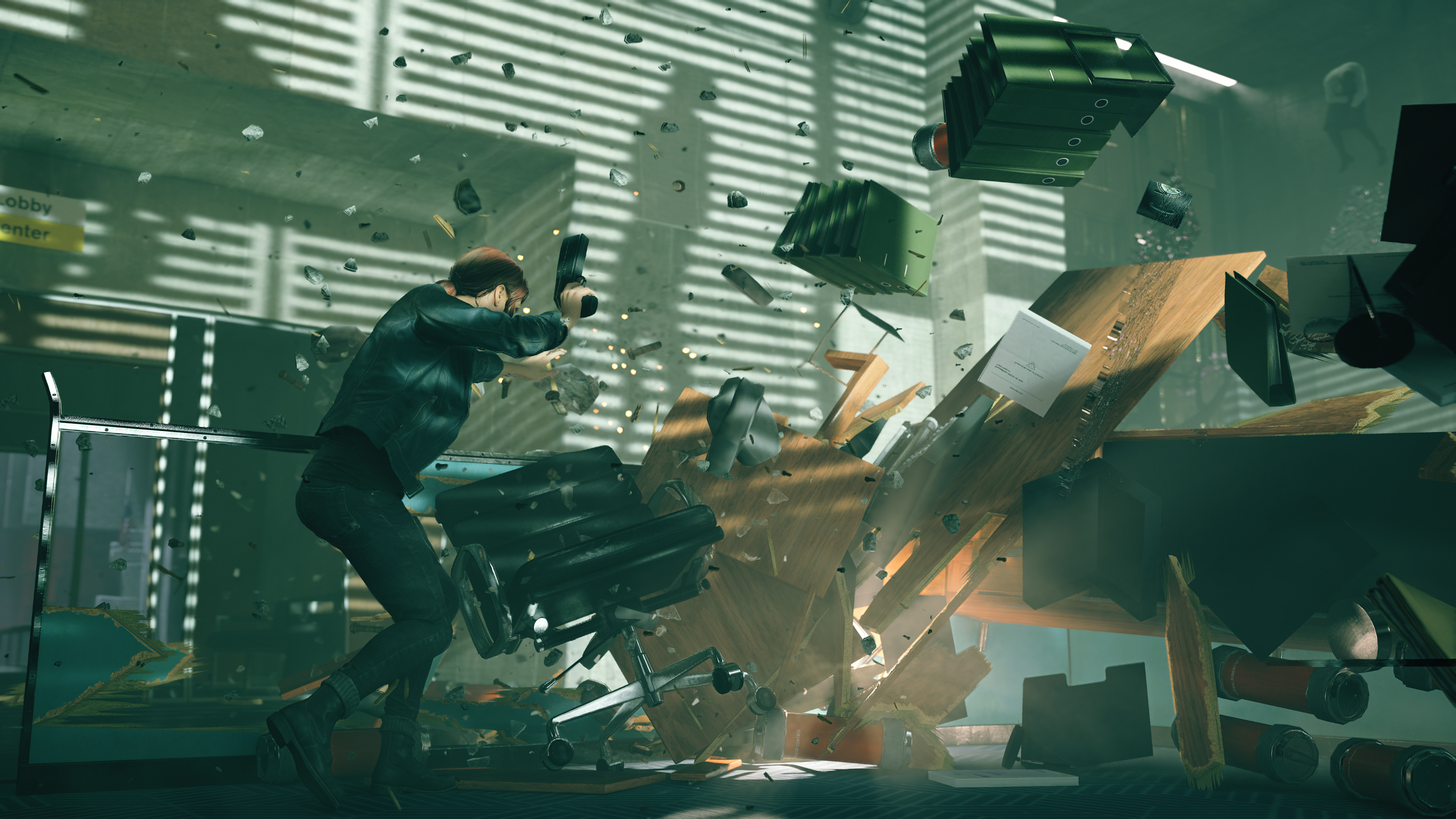
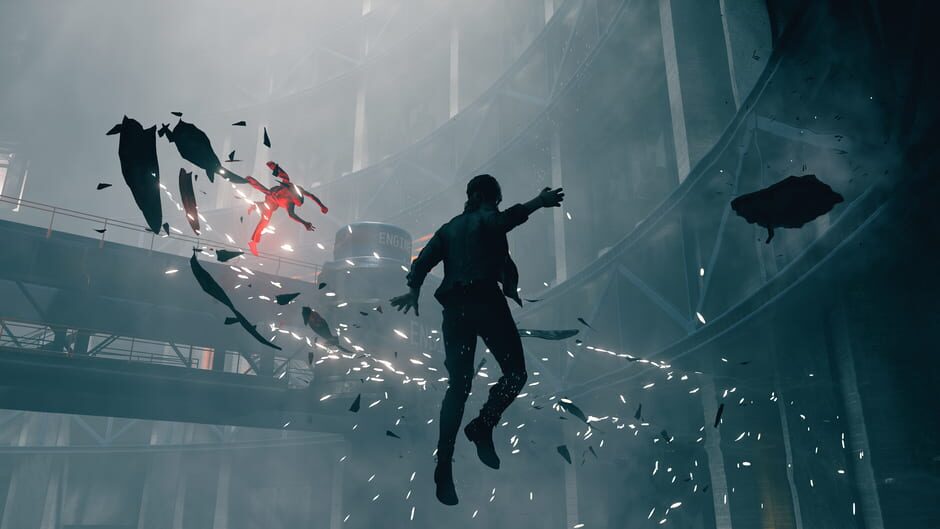
It's a shame, really, as the actual controls of Control are pretty good - being able to use telekinetic powers always correlate to a good time, in terms of gameplay. Picking up the new powers of levitation and mind control as the game progresses also help to clear away the waves of enemies, as you become more experienced. But, what initially starts out to be some creepy Hiss baddies, eventually gives way to simply running past them in order to progress with the story, due to said frustration - so you don't end up utilising these as much as you might want. 

The skill tree, as you might expect, is pretty standard - although getting additional skill points is directly linked to upgrading other parts of the game. You can even improve your gun with points collected by defeating Hiss agents and random pick-ups from your fallen foes, which leads to some interesting personalisation of your weapon. It's definitely recommended that you do this regularly, in line with your own gaming style, as the powers Jesse gains throughout Control are limited by her energy - a nice added feature that ensures you aren't simply throwing everything around until you're surrounded by dead agents of the Hiss. 

As a result of all of these points, however, Control simply isn't as fun to play as I expected. There are definitely a lot of good points to this game, but the overall feel of the story is more tedious - and even irritating at parts - than it is enjoyable. Exciting moments might give you a second or two of "ah, that's cool" but, beyond this, I never felt like there was a need to keep pushing forward - a feeling enhanced by the underwhelming ending.  

My advice, when going into this experience, would be to do so with an open mind and no prior knowledge of the game itself. The hype and positive reviews may lead you to the same experience as I, so I wholeheartedly recommend taking this with a pinch of salt. Enjoy yourself and take your time when exploring, to ensure you don't miss any extras (as I did, before having to backtrack in order to progress). If you're looking for story and a linear narrative over the gameplay, then this probably isn't the right genre for you - but if you like killing baddies and getting in-game points, then you may well enjoy Control for all it has to offer you. 


Sunday, 29 March 2020

Interview with Screenwriter and Actor David Hayter


David Hayter is definitely a busy guy. When I first contact him to request an interview, he is quick to accept and more than willing to offer up as much time as I need – but finding that time is a very different story. Between his busy schedule and well-deserved downtime, we go back-and-forth for a short while, in an effort to slot a chat in. In the end, it comes as a last-minute message, “can you do today?”, and with a very happy acceptance from myself, we manage to squeeze in a few hours between his morning writing and an afternoon meeting.

Beginning with a brief chat about my unusual accent, he manages to pin down not only exactly where I’m from, before I have a chance to explain, but follows with a dead-on impression. It turns out one of the reasons he’s able to do this is due to his previous talks with the legend that is Alan Moore. Of course, for those who follow Hayter’s history, they will know he has worked on the master novelists previous work of Watchmen – a popular textual transformation of the graphic novel created in 1986-7.

“I was actually over in Manchester about 2 summers ago, for a comic con. It was very nice! And ‘Hayter’ is actually Welsh, so it’s really like my homeland”. Travelling for cons, of course, is part and parcel of David’s job – but he was a sufferer of wanderlust long before his career took off. Canadian by birth, he and his mother travelled considerably as kids, before he returned from Japan at around the age of 20, when he eventually moved back to California. These early years of adventuring, it turns out, were a key part of how he got into performing.

“To get to know the community, my mother would take part in a lot of community theatre projects. We moved to California when I was 9 and she saw an ad for a kid's theatrical production of Pinocchio. She told me to audition – so I did – and I got the part. After that, a girl asked me for my autograph, and I thought ‘oh, this is pretty good’. The writing came up later than that, when I was about 12.” 

Growing up at a time when Star Wars and Indiana Jones were hitting the pictures, Hayter was inspired to write stories of fantasy and adventure, along the same lines. And so, he began to put pen to paper, in an effort to bring his imaginary worlds to life.

He laughs when I ask how this turned into a profession, “I don’t think I ever became a professional!” he remarks, before going on to say how he managed to write a full script when he turned 22. “It was a terrible vampire script. I had a director attached and we tried to get that set up but never quite did. Apart from that, I never thought of pursuing writing as a career”. Like so many, he was working hard in every way he could, in an industry he loves, when he “fell ass-backwards” into his first professional scriptwriting job.

 “I got a job answering the phones on the movie X-men, but I knew the director – so, I suggested a scene to him and he went ‘yeah, go write that for me, let’s put that in the movie’. After that, I was doing re-writes. By the end, I had done so much writing that I ended up getting sole credit.” At this point, I can’t help but comment on the rarity of having a director allow for a perceived outsider to have so much impact on a major film. “Yeah, he wasn’t precious about it, at all. It was good of him to do that, and it helps that he wanted a writing partner who wasn’t tied down by contracts and one-step deals. He could make me write as many pages as he wanted, I was just always there and able to make changes.”
David Hayter new profile picture on Twitter is...pretty good ...Naturally, it helps to always be available to your director when they want or need you. That said, having such an intimate knowledge of the characters – and how they think, act or interact with each other - before you need to write about them, can be a major benefit.  Being a big pop culture geek and gamer at heart, David inherently knows what works and what doesn’t, when it comes to writing up a script or voicing a beloved game character. Yet, this doesn’t always have to be the case, “there’s no one way to do it – it’s a different path for everybody. I was hoping that, when I arrived, they would turn me into Tom Cruise. Unfortunately, it didn’t work out that way”.

He is keen to point out that, in the “8 or 9” years it took him to start acting and screenwriting at AAA level, he had to venture into other areas of Hollywood life, which led him to voice acting among other career paths. “That’s just how I found my niche, it’s how everyone finds their niche” he states, when I ask if the variation is important to professional development.

In terms of his personal preference, when it comes to acting over writing, there are no clear winners in Hayter’s’ eyes. “I prefer the job of acting, above anything – particularly voice-over, which is just great fun. But I prefer the career of writing, because you have a little more control over where you’re headed and the projects that you get to do”. At the end of it all though, this is clearly a guy who is enjoying how his trajectory has curved, as he loves almost every aspect of every gig he takes on.

“I think all actors should learn about writing, and learn to create their own material” he mentions, when we discuss how both sides of his career can help to support the other, “it’s the only way, as an actor, that you can have any control over what you do and what parts you get to play”. So, does his work as a screenwriter allow him to shift and change up any scripts he’s given? Not necessarily – but it certainly does no harm when he finds himself writing up new works.

“It definitely helps when you’re creating something, to know how the lyricality of the voice works off the page. Dialogue that looks good on the page, doesn’t necessarily speak well – and vice versa. I turned in a script for a show last year and the showrunner actually said to me ‘your dialogue worked a lot better than I thought it would!’. But that’s how people talk – it can look simple, or fragmented and even monosyllabic – in the end, the rhythm is there and it’s real”.

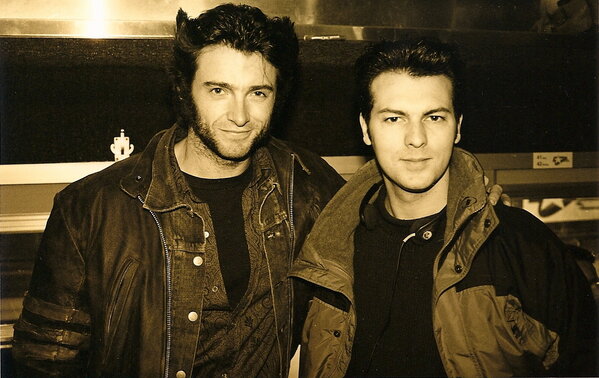
David Hayter on Twitter: "@Dak_N_Jaxter "Saw you and Hugh Jackman ...There’s a running theme here, between David and other actors I’ve spoken to in the past, where music and voice acting seem to run concurrently with each other. So, I quickly chime in and ask him if he has any musical background, to which he responds “yeah, actually, I went to Ryerson Theatre School in Toronto, which had a strong music component to it”, before he laments his dancing skills – which they also attempted to teach him.

“I’m also learning to play the guitar” he drops in, casually, before discussing how working with music helps him to activate a part of his brain that allows him to relax and regroup his thoughts. “If I’m writing all day and my brain is just cooked, I can sit down and lose myself in the guitar and the music”. Here, we agree, the order of mathematical elements found within music can help to engage a completely different side of your abilities. “Writing can really suck the life out of your brain, especially if you’re doing 8 hours a day, to a point where you can’t really even communicate anymore. So, using music, you’re able to refocus on what matters”.

At this point, as I’m sure you can tell, it’s clear that David is remarkably easy to talk to about almost anything. This seems to be a recurring theme within the voice acting and screenwriting world, which leads me to ask whether being able to gel well with a team is something that is essential to the job. “It’s definitely not essential – but being fun and engaging will take you a lot further than being an obnoxious prick. I think a huge benefit to the ‘Me Too’ movement is that there has been a real effort for people to behave better, too. I’ve always tried to be respectful, of course, but there’s definitely a lot less lunatic, a-holes to deal with now!”

Working in Hollywood is, without a doubt, very stressful and David makes a point of highlighting how easy it is to become swept up in heated debates about budgets, time and pressure. In order to combat this, he looks at those he works with and always tries to make the job engaging and fun for them, as well as himself. “That’s also where the acting side of it can come in,” he tells me, “because most writers are generally very isolated people. That usually leads to them not communicating particularly well, face-to-face, as their work almost entirely consists of written correspondence. But, if you’ve been an actor and had to go through hundreds and hundreds of auditions, it becomes a lot easier to talk to people and interact”.

As it turns out, this is also a key part of staying cool when meeting with directors or pitching huge projects that are close to your heart. While David describes himself as being fairly confident in his abilities, his general demeanour is calm and open - and he’s clearly open to working with the many criticisms that come with writing and acting. “The more relaxed and confident you are, the more likely they will be to hire you and the more confidence they will have in you, as their writer or actor”.

Thus, the biggest piece of advice he can give to new writers is to simply practice being confident when they’re going in to give a pitch. “’Fake it til you make it’ is a common cliché – but it’s true. Watch videos of confident people and do what they do - I got it mostly from Harrison Ford or Tom Cruise. Just watch these people who are so otherworldly confident and create your own take on that. Don’t talk too quickly, don’t be too solicitous and try not to use your nervous face!”.

It’s clear that David Hayter is able to deal with the comings and goings of a fast-moving business with apparent ease, so I’m keen to discuss how he manages stress – particularly at a time like this, where so many people are looking to avoid stress through their writing and other creative outlets. “I read a lot about Buddhism and the Dao, growing up in Japan, so I basically have learned to meditate.” He says, before going on to mention a great technique he learned from a book called Ransom, by Jay McInerney. Using the same system as the character in the book he meditates, one-by-one, on the problems he may be having. “Whether it’s a horrible fight with your girlfriend, or a looming test you don’t feel prepared for – you treat it in the same way. Focus on each one, pluck it out of your brain and put it in a box – and do this for each problem. Once you’ve done that, take the box and set it on fire. Just let it all go.”
Solid Snake voice actor David Hayter
This is not entirely dissimilar to CBT techniques I was taught and have worked with previously, whereby you take a look at each, individual problem and focus on ways to overcome these, separately. Of course, there is no burning box, which means there isn’t quite the same feeling of catharsis. However, upon mentioning this to David, he tells me of another method which he finds is a great way for dealing with writer’s block and general frustration – ideal for working in conjunction with the McInerney technique mentioned, above.

“Just before I got the part of Snake, I read a book called The Artist’s Way, by Julia Cameron -it’s like a workbook to help you reignite your creativity. A big part of that is, in the morning, you just need to write everything out, like a stream of consciousness. Nobody will ever see it, just go for it and you’ll be able to put your problems into perspective.” This technique, he excitedly goes on to say, is also a fantastic way of getting your brain over humps in your writing, “just rant about where you’re at in the plot, and what you’re struggling with – just let it all come out on the paper. In the end, your brain will just start throwing out random ideas, and you’ll suddenly find the problem is being resolved, purely through this technique”.

This, then, explains how David is able to always maintain his composure – even in the most stressful situations. That said, while he strikes me as a very relaxed guy who enjoys the job, whether he sees himself as a laid-back person is still up for some debate. “Sure, for the most part, I’m pretty relaxed. I’m still laser-focused on my work and I’m probably not someone you want to fuck with, though. It’s not so much of a problem anymore, though. When I was younger, I was definitely more problematic!” he tells me, and we quickly exchange stories of being – for lack of a better term – little shits, when we were kids. “That’s good though!” he laughs, “it means you’re living your life and experiencing what you can, despite it all”.

Talking about turns and the unknown, we then get on to what getting the role of Solid Snake meant to him and how it changed his life. “I knew it was always going to be big. I saw the artwork, the cutscenes, and was generally aware that Sony was going to be pushing this – but I had no idea that I’d be talking about it 22 years later. Going around the world and signing autographs, while doing video shout-outs with the same voice”. Nine games later and still very active on the circuits, his Cameo is full of requests for Snake. “It’s the only voice that gets requested! I’m one of the lead Jedi in Star Wars: The Old Republic – nobody ever asks for that!”.

While it’s something he is clearly very happy to do, it still surprises me that so few people have knowledge of Hayter’s writing career or other jobs. This, he says, is due to a distinct lack of follow-through on work that he completes. “I didn’t realise how many of my scriptwriting jobs would actually lead to a movie. In those first few years, I wrote 8 scripts which actually became movies, out of roughly 20 - and I’ve probably written about 40- 45 movies in my career.”

David Hayter on Twitter: "Liquid. Raiden. Snake ...In the end, he decided to side-step his career and work from a lower rung, on a different ladder. By heading to Netflix and asking to be a part of a full writing team there, he feels he has made much more personal progress toward his goals and lead a more fulfilling career. Of course, TV writing is very different to film writing, so he offered himself as 3rd or 4th in the room, without the ties of big budgets and lead credits. “Many people might take it as a step back. I used to be an A-list writer and now I’m a mid-level writer - but it’s fine. It works and it’s invaluable. By putting my ego aside, I found a new way to work to my best ability and get the best projects done”.

The risk, however, has clearly paid off. David now sits at 2nd in the room and has credits as an executive producer, for the show he’s currently working on. “It wasn’t that difficult in the long-run and I’m really happy it’s gone that way. So, my main advice for anyone breaking into the industry would be to not to get too full of yourself – and don’t always believe your own hype. Just be willing to do what it takes to get the best and be the most helpful to everyone on set”.

It’s fair to say that this summarises David Hayter exceptionally well. Like many in the industry, there’s no ego and no continual desire to be “better than” (whatever that may be perceived as) beyond bringing your all to the work and beating your own PB, as it were. Whether it’s Nolan North, Jennifer Hale or Roger Craig Smith, each personality takes criticism in their stride, works hard and makes the effort to get along with their team.

I can’t help but ask if all voice actors have this sense of humility, to which he responds, “I’m fairly confident when I say ‘yes’. Everyone I have met in this industry has been really giving and kind – pretty much across the board, everybody is super nice. Everybody is just ready to play and just dive in. In particular, with fans, the voice-over group as a whole are just spectacularly nice. And they want the best for you, and they know that the fan’s experience in meeting them means so much. For example, Nolan North is just this amazing, hilarious, lovely guy. If you come to us as a fan, we will always make sure that you feel validated, supported and listened to.”

In terms of his writing, David is a big fan of mixing his gigs by working alone, as well as with others. Usually, working on TV means he’ll be a part of a bigger group of people, where he appreciates the camaraderie that comes with team writing. Meanwhile, films will require a lot more solitary confinement in order to get the job done – or, at least, they do during the first draft. This particular point in screenwriting is one where he encourages complete creative freedom, and takes great pleasure in having fun with the plot, characters and settings – because he knows nobody else will read the work at this stage.

So, just how does the process of writing up a screenplay work? Naturally, it depends on what he’s been tasked with, first and foremost. However, given that he is now a master of transforming text to on-screen productions, the process he uses to get pen to paper, for these productions, has been finely honed. “I always go back to the source material. I read through it and, when I’m done, I put the book away and make notes of the key plot points, the great ideas and great sequences. If there is something in there that I can’t remember, then it means it didn’t make an impact when I read through it. So, the question then becomes how I change that into film structure, and push on from there.”

From here, he says that building on his work, follows the same metaphorical process as creating a katana. “Story development works in the same way as the sword is made, in that the metal is folded over and over until it can’t be broken. When you create a story, you’re always going to be pouring back over the material, folding it over and over. Eventually, it feels like a world that really exists – it’s a living, breathing world”.

Even then, there’s a huge element of compromise at play – and the more expensive the project, the more debates you’re likely to have with executives. The biggest key to handling this, Hayter tells me, is to remind yourself that this is not your project – it will always be in the hands of the studio, because it’s not your money. “You don’t own it. They own it. They may tell you to do things that are terrible for their project and terrible for you, as a writer. However, you have to learn how to negotiate that and work on ways to incorporate their ideas without derailing the project”.

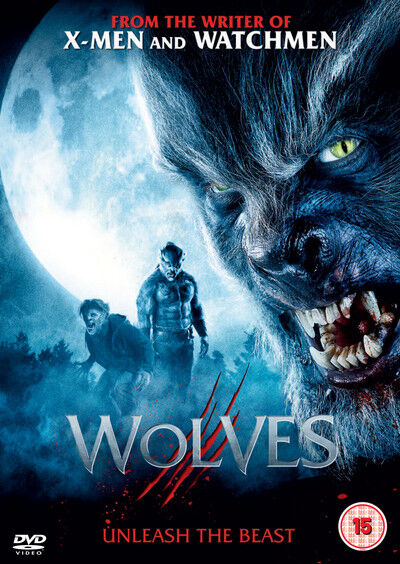
Wolves Written and Directed by David HayterDon’t forget, there are some good executives out there who will always give you good advice, too – so don’t be too downhearted. Just keep your head on straight. As always, David is keen to keep his feet on the ground during this phase. “Editing is where good writing comes from. So, I try not to be too hard on myself, and I also try not to get too excited about my work, which allows me to be harsh on the work – but not on myself, during this process”.

Sometimes things don’t work out, through no fault of your own, and you might find that – after all the work you put in, the writing, editing and arguing – the gig still gets scuppered and you’re back at square one. “It’s horrible. When it first happens, it’s soul-crushing. If you’re a working screenwriter though, it’s going to happen again and again, and again. So, you’ve just got to deal with it. There’s been times when I’ve spent 6 months, unpaid, working on a pitch and then, after a couple of calls and meetings, they decide they’re not going to go with it anymore.” The biggest piece of advice he gives me at this point, is to never get your hopes up. Don’t expect it to be in production until it’s in production.

So, is he able to talk about the projects he’s working on, now? Unfortunately not. But he does tell me that he has a few things in the pipeline and to keep an eye on what lies in store, in the near future – and that he’ll get back to me for another interview when this is released. For now, you can still find him on Cameo, where he’ll be fulfilling the many requests you have. If you can't wait until then, you will be happy to know that the Q&A version of this interview will soon be up, over on The Valkyries website.

Sunday, 15 March 2020

Interview With Voice Actor Roger Craig Smith


Quick Note: This interview focuses on the personal success of Roger Craig Smith, as well as his thoughts on Hollywood, 21st-century living and the highs and lows of his life. For those seeking out more voice-over related Q&A’s, you can check out the sister article to this interview, over The Valkyries website.

When I first get a message off Roger Craig Smith, I’m completely thrown off. You see, Roger is a popular voice actor who is known for bringing life to characters as well-known as Batman, right through to the Mouse in If You Give a Mouse a Cookie. This is a busy, uniquely talented guy and the idea that he wants to get into the nitty-gritty of voice acting with a UK-based writer is a surprise in itself.

Of course, if you were to speak to the man in the flesh, you’d quickly find out that this gentleman has no interest in labels and is simply seeking to make the most of his life. Indeed, it’s not just voice acting that he focuses on – rather, this is simply how he makes a living. Him taking time out of his day for me, as it turns out, is just another way in which he pays forward his energy to others.

Roger Craig Smith
Photo by Jen Rosenstein
It doesn’t take long for my nerves to show but, honestly, Roger is so laid back that these subside within a few minutes. After all, he can talk about pretty much anything – and that’s exactly what we do. Starting off gently, we get into how he began voice acting.

As it turns out, like most of us, RCS was originally looking to do something completely different. Beginning with a career in screenwriting, he tells the tale of how he side-stepped into comedy because he loves to make people laugh. After a good few years of what he refers to as “mimicry and theatre arts”, it was only after trying out for the Aspen Comedy Festival that the repeated question as to why he isn’t voice acting made him consider it as a career.

Even then, this isn’t something he took lightly. Instead, while pulling some shifts at Dave & Busters, Roger researched the best ways to get into voice acting and invested some quality classes, where his voices and acting chops were honed to a fine point. It was only after this, that he got together with a friend and asked them to help him get his demo reel together, in exchange for $50, which was then sent out – in person – to anyone and everyone who would listen.

“You have to treat it like entrepreneurship. You definitely need a business approach” he tells me, as he highlights how important it is to give yourself a solid foundation before heading straight to clients, “that, and the ability to talk to people on a human level – a skillset that is quickly being lost”. With this, we start talking about the small steps he took to ensure he edged his way into the Hollywood industry. Demonstrating perfectly how luck only lands on your lap when preceded by hard work, Roger tells me about how he worked as a PA in the industry through making sure that he spoke to everyone he came across about his ambition.

Valerie Macon RBTI Premiere 00001Like everyone who wants to achieve as much as possible, dealing with rejection is as commonplace as getting a gig, and Roger’s response to this is as pragmatic as you would expect. “It happens all the time”, referencing the Sonic move “you just have to keep yourself focused on what you want, and be grateful for what you have”.

“We’re all just trying to survive – look at this virus. It’s just trying to survive, and it reminds us of how weak and susceptible we are. There’s no winning, there’s no losing and no finish line.” He’s not actively being bleak, however, and he assures me that he’s aware of how others can view his body of work and takes pride in how these help people to have a touch of escapism. In fact, he makes a point of reminding me (and himself) that the real world is what is going on outside of his job.

“Keep falling forward. You’re gonna slip up and keep falling. You might be crawling. But, all of a sudden, you’ll look back and say to yourself ‘oh man, I’ve been crawling at times and sprinting at others but I’m so far away from where I was’ and I’m still doing that”.

Whether it’s politicians, athletes or actors, it’s generally agreed that these people are, in Roger’s words, “pedestalised”. All of these public figures are portrayed in a way that is sensationalised, whether that be the best or worst of their personalities and it’s quickly brought to my attention that, just because we might not agree with someone, it doesn’t mean that we should stick them on a pedestal and use them as an example of who we should – or should not – be. “You’re just as capable as these people at being imperfect. I hope that when we eventually work our way to the other side of this social media experiment, we all realise that everybody has got stuff – the good and the bad. You have to allow for people to grow and make mistakes – with bad behaviour being punished as is applicable”.

He bemoans those moments where he finds himself comparing his life to others, in which he can often consider his life as ‘less-than’ anybody else. “I’ve had the benefit of growing up without it, whereas kids today are growing up with everything on screens. Their whole existence has been staring at screens and it’s sad – and I hope there’s a pendulum swing back to the other side”.

Naturally, this cynicism does come a place of experience. When Roger was in his late 20’s, he suffered with a severe bout of pneumonia, which left him hospitalised for 6 days. As I’m sure you can imagine, this was not a pleasant experience. And yet, in typical RCS style, he quickly bounces back with “now I know what people mean when they say ‘at least you’ve got your health’!” – a phrase he certainly believes in. And one that we discuss, in-depth, while chatting about the differences between individuals whose viewpoint in life is much more hardy and positive than we’re often able to see, online.

On the other end of the scale, there are also those whose entitlements can bring down the overall mood of a studio. “You see it a lot in Hollywood. Now that the gaming industry is making a LOT more money than it used to, we’re seeing an influx of influencers and on-screen actors coming into the studio. And a lot of these people have no respect for the industry as a whole, which you can see in the way they treat the process”. Referencing a few moments he’s had with past experiences, he is also careful to offer the viewpoint of Troy Baker (his co-worker and friend), who has argued that anyone who is capable, and right for the role, should be able to work in any industry. “I just have a bit of a chip on my shoulder about it, because I think it can make the whole process harder when you get the wrong person for the role”.

It seems only natural at this point that question of what makes a voice actor so good at their job comes up – is there a secret formula that will lead the everyday person into the role of voice-over work? “The art and the unique element comes into it, for you as an individual, when you can take something that has been done before and twist it, to turn it into something new. It’s always on the fly and it always comes down to who you’re working with”.

It seems that, if you can speak faster on command, add an accent where required and maybe throw in a couple of idioms and/or speech impediments, you might just be on your way. Whether it’s adding a soft Russian accent to Batman in
Superman: Red Son (available digitally, now) or mixing together a range of accents into what he calls “Italiaspanglanish” for Ezio, there’s a huge array of examples of this, within his body of work.

Of course, this is easier said than done, as many hard-working actors find out along their journey. “That’s why you’ll never have my career, and I’ll never have yours. That’s both the beauty and the hard part of doing what we do. There are so many new people coming into the studios now – but there are still so many recognisable voices that you can hear, as soon as they hit a certain cadence or delivery”. This isn’t an industry of impressions, after all, it’s about flavouring your character with the right tone and inflections. At the same time, all of the technical stuff can be taught along the way.

He does, however, state that he’s also a bit of a homebody, as he’s hyper-aware of keeping his vocal cords relaxed and ready for whatever job is next. “Staying physically healthy is important and getting lots of rest is the only way to keep yourself ready for whatever is coming next, so I try and stay healthy”. Still, he’s keen to point out that he doesn’t do any vocal exercises beyond knowing what his current range is and staying away from work that could possibly harm his potential for the next gig.

This is one of the reasons why Roger stays away from so many conventions. While he always appreciates his fans, which you can see in how he converses with them on a regular basis through his Twitter and Instagram accounts, doing weekend-long work can be damaging. “You’re jet-lagged, you’re talking all day long and hugging people, shouting over background noise and doing impressions of your work, constantly”. Even short stints during talks at his local college, where he offers his time to audio students, can have an impact on the stress caused to the vocal folds, which has a knock-on effect to his work.

There’s no doubt that Roger is opinionated in the best possible way, in that he is continually considering different angles to an argument. As with most intelligent people, he takes everything in the world with a pinch of salt and seeks to escape any bitterness caused by that salt, by getting away as much as possible. At times, this means chasing down as many different pursuits as he’s able to fit into his busy schedule, such as American Sign Language (ASL). At others, it can simply mean going down a mountainside as fast as he can, on his bike. 

One such pursuit that he has become increasingly associated with is his astrophotography, which you can catch on My Shots in the Dark. Initially starting out with an interest from a young age, he decided to take things a little more seriously once he had some money to play around with. “I bought a rudimentary telescope and – out of sheer luck – focused on what I thought was a star, which was low on the horizon. It actually turned out to be Saturn, and I could see the rings” he says, before mimicking the state of wonder he found himself in. “Then I wanted to find out how to take a picture, so I went online and researched as much as I could – and it just went on, from there”.

A shot of RCS by Babek Tafreshi
This is a fantastic summary of a man whose default face reverts to a gentle smile, when discussing the unique aspects of space and how much has been left undiscovered. Roger is definitely a guy who can show dedication and perseverance, in order to get the right shot – something he enjoys sharing with his followers, whether they appreciate it or not. “It’s the perfect hobby for a guy who works during the day and wants to enjoy some downtime at night, where I don’t have to be interrupted”.

Through this, he has also discovered the International Dark-Sky Association, whose work revolves around reducing the impact of light pollution, which can affect wildlife and human health, as well as be a huge source of waste across the world. Knowing that RCS has been approached as a delegate, I quickly ask what we can all do to help reduce our own light pollution, to which the answers are as simple as you might expect:
  • Put a cover over any outdoor lighting, so the light is reflected downwards
  • Try to minimise your usage of outdoor lighting
  • Consider the types of bulbs you’re using (LEDs are fine, just try to avoid blue light emissions)*

Unfortunately, at this point, I’m aware that we’ve been talking for two hours and, as giving as he might be, I definitely don’t want to eat into too much of his time. So, I finish off with a question of what he would send into space. His answer, which catches me completely off-guard, involves shooting a doll of Ezio out, which slowly dissolves due to radiation – but not before taking down the International Space Station. And I really can’t summarise my short time with Roger Craig Smith any better than that.

Stanley MW 08-20-17
If you look, really closely, you might just spot Ezio causing the downfall of science

*More info on this can be found on the IDA website


Wednesday, 18 October 2017

First Look: Sigma Theory


     Sigma Theory is the latest offering from the team of Mi-Clos Studios and FibreTigre, also known as the team who brought us the multi-award winning "Out There", and it's every bit as deep and evocative as it's predecessor. To read it's summary often ends with more questions than answers, so I decided that this was something I was going to have to look up once I arrived at PlayExpo.

   I wasn't disappointed. It's a game that doesn't sit too well with descriptions, as it's blurb can attest:
"Sigma Theory is a single-player near-future espionage strategy game that takes place during a new cold war."
   
However, once I started playing the preview that was available at the convention, it suddenly became much more clear. Sigma Theory allows you to hire spies- all of whom have their own strengths and weaknesses- and send them out to obtain information. How they get that information is up to you and what you do with it can either lead humanity into a utopia, or to ruin.


        The joy in this game is that there are no bad guys, unless you decide to become one. Your spies have free will and can rebel against you at any time, depending on what you make them do or what type of person they are, and you can cause your spies to be caught and killed in action. Every choice you make will have a knock-on effect for the rest of the game and losing information does not mean that it's Game Over. 


      This is a well thought-out game, that has a rather meaningful origin. When asked what sparked the idea for the game, the creator Michael Peiffert told me "it started with a discussion between me and my friend. We were discussing politics and how it is so easy for everyone to say 'this decision, that the government has made on our behalf, it's so stupid'- but we don't know the whole story. The politicians have so much more information, they have so many secrets and we thought 'what if we can make a game, where we put people in this position?'. So that's what we did"


    It's easy to see how you could lose hours playing Sigma Theory. The game makes a complicated premise really easy to use, and it's a credit to the developers. Most importantly, this game is fun- and I can't wait to play more. 

Thursday, 12 October 2017

Play Expo: What's On, What's Good and Why

Play Expo is getting bigger and better, year after year, and I've been blessed with all the inside info (which I, in my infinite generosity, will pass to you!)


        In case you haven't heard, The North's biggest gaming expo is, once again, blessing Event City in Trafford Park with gaming exhibitors, special guests and nearly 1000 playable consoles, handhelds, PC's, arcades and even pinballs to play- and each one is going to be jam-packed with classic and retro video games. 

All free to play. 

Heaven.


Everything from tabletop gaming and VR headsets to cosplay and shopping- and everything in-between is going to be demonstrated under one roof! Can you tell I'm a little bit excited?

Ahem. I'm sorry I'll calm myself, now.

       One of the best parts about this Expo is seeing all the smaller, indie games that quickly get snapped up by the big companies- like Hyper Sentinel, which has just been selected for the all the big names, including PS4 and Xbox after humble beginnings on Kickstarter.
      Then there's some amazing new releases being previewed such as The Sigma Theory. A complex, turn-based/ tactical behaviour/ espionage game that takes place during a new Cold War era, in the near-future. This game is up there on my "to-do" list at this event, as it sounds both a little crazy, fun and like a bit of a mindf*ck. Check out the trailer here.

     Seeing these guys on the same level as the big guns, such as Crash Bandicoot's latest (/oldest) N.Sane Trilogy and Halo-2 gets those guys the exposure and accolades that they deserve, and it's pretty awesome to think that 25,000 people are expected to crash through the doors to play on ALL kinds of games, no matter the studio. Heart-warming stuff.

       And from the newbs to the golden oldies- Psygnosis and it's many, many years of experience will be on full display along with the 25 years of experience the team clocked up. That's right, the minds behind Lemmings, Shadow of the Beast and Wipeout will be there for a Q&A, reminding us why the Psygnosis logo is one of the most Nostalgic images I've seen in a long while.

Remember this guy? Owl bet you do

     Not to mention the original retro machines that played host to the classics, including Sinclair, Commodore, Nintendo, Sony and Sega. And all this retro-gaming is topped off with a RetroCollect Tournament. If you're wondering what that is, it's basically a big, retro-game tournament


If this all seems a little mad to you, don't worry I'll be reporting on just how amazing it will be and maybe next year you'll be prepared for the insane journey. For those who want to come along and have a go tickets are here but are on the verge of selling out so act fast and I'll see you there!


Sunday, 31 May 2015

Things Pregnant Women Are Sick of Hearing

Yes, we're pregnant. Yes, we know you're trying to be nice. No, it's none of your business. No, you're actually being annoying, insensitive and, at times, just plain rude.

"Are you sure it's not twins?"
Yes.

"Wow. You're huge!"
Can someone explain to me at what point being pregnant means it's open season for bitchy remarks? In what other scenario is it ok to say this to someone?

"Just you wait until baby is here!"
Because I have NO idea how hard caring for a baby will be. Let's just say, for the sake of argument, that I am completely clueless and think baby will be a breeze- and get hit by a shitstorm (quite possibly literally)- how is your smugness going to help me?

"It's just a bit of sickness"
No, it's not. It's over 35 weeks of constant nausea, being unable to eat, brush your teeth or smell certain things without suddenly running to the loo. And, because you've not eaten anything, you genuinely feel like your body is trying to expel the stomach itself, which makes your abs ache like you've done an epic workout like never before. This is exacerbated by the fact that your abs are in danger of separating throughout your pregnancy, so you actually do more damage to yourself, even though you can't control it.

"You're not going back to work? Isn't that a little lazy?"
You're right, taking care of tiny, defenceless humans who rely on you for everything from food to literally wiping their ass for them- as a minimum- is lazy (did I mention that the above needs to be taken care of every two-three hours on average? And that's whether you're sleeping, eating or trying to get to the loo, yourself). This doesn't make us bad parents, it means we put baby's needs above our own.

"You're going back to work? What about your baby?"
I was thinking about turning him/her off for a while. Seriously, as if it wasn't hard enough to give up such a precious, important and short time with your little one, we have another judgemental ass making us doubt our ability to provide for our baby. The simple fact is, we would all spend as much time with our families if we could, but sometimes we need to sacrifice that time in order to provide that damn money that disappears from our account about a week after we're paid. This doesn't make us bad parents, it means we put baby's needs above our own.

"Are you breastfeeding?"/"Breast is best"
Excuse me, I didn't realise this was any of your business. Remind me, next time you're shovelling endless sugar/snacks/takeaways down your throat what a glorious nutritionist you really are. If you decide to breastfeed then that's awesome, cause it takes a lot of time and energy to feed direct from the boob (although there is the awesome advantage of being allowed an extra 2000 calories a day). If you can't or decide not to, then that's awesome too. It's not for everyone and you'll make your baby much happier than putting yourself under endless stress if things aren't going the way you want (baby will know if you're stressed- happy mummy=happy baby). Besides, isn't the real-world application of science how we've made so much progress? ;)

"You're keeping your dog/cat/chinchilla etc.?"
Acting as though you know a woman's family better than she does is a sure-fire way to get yourself in the doghouse, at the very least. Questioning her ability to care for/protect them while she's pregnant?! That's bordering on insanity.

"You're getting rid of your dog/cat/chinchilla etc.?"
As above. This isn't a decision that's taken lightly. Pets are part of the family but sometimes need to act for the greater good and making someone feel guilty for thinking of others is the worst thing you can do. Expect a reaction similar to an angry bear being poked at with a stick

"Baby will come when it's ready"
I know but I want to meet her now

Speaking of which..


WELCOME TO THE WORLD, BABY JJ!

Monday, 30 March 2015

Quick DIY Tutorial for Those Who Aren't Particularly Crafty

I just wanted to quickly pop this up here, as I know some may find it helpful. I've started work on my nursery and, being of little money (and I mean very little), I decided to do everything on a budget. Which mostly means I get to make a mess and pretend I'm oh-so-crafty. Thus, I have painted the walls to match a theme which I hope isn't too girly or overly 'neutral' (which mostly means yellows and greys, apparently).

You'll need:
Some paint brushes (I picked up a set of 5 from eBay for £1.49)
Pencil (and sharpener)
Eraser
Brown paint (if you have an eye for detail you may like to get a few shades)
Green paint (as above)
Colours to match whatever theme your going for
Mayyybe some decals, to finish it off (mine were roughly £2 for a sheet of 30 butterflies, and I bought two lots of different colours, on eBay)


Step 1

Make sure your walls are clean and well-prepped.
If you have recently painted, wait for the walls to be thoroughly dry before making your move (I live in the UK, so it'll generally take roughly 2-3 weeks, usually).
If you aren't painting, or haven't painted recently, grab some sugar scrub from a DIY store, or online (roughly £2-£5 depending on where you go). This will help get rid of dust and general rubbish that may have built up on your walls over time- which is brilliant for sating that nesting appetite- and will help the mural your painting last longer. Always follow the instruction given on the bottle and keep the room well-ventilated!

Step 2
Grab your pencil and start drawing the outline- the easiest way I found was to move in one direction in a smooth motion. If you make a mistake, just go back to where the mistake started and continue as if nothing happened- you can erase mistakes later with either paint or an eraser so don't worry about them now.
Your tree will most likely differ depending on your drawing style. My particular drawing style is something I like to call 'clunky' (which is a nice way of sayin 'sh*t') and, if I had the intelligence to think ahead, I would have taken a picture at this point- but your general aim is for something along the lines of this:


Step 3:
Fill in your lovely outline with your brown paint (or paints, if you like to add the knots and boughs that trees naturally have- shockingly, I didn't) so it looks like the one above.
Now, let's all agree that the one above does look a little too Halloween-esque for a babies room at this moment in time. I was thinking about filling in that little hole with a darker brown/black and popping an owl in there but was concerned I might damage my child for life, so opted out.

Step 4:
Add your leaves! The easiest way to paint leaves (in my opinion) is to do two quick, short strokes of your brush, from the top of your leaf, outwards slightly and meeting at the bottom, in the middle. Don't worry if yours turn out a little fatter or longer than mine. I like to think of this as being something you have created organically for yourself and your kid- rather than see these as mistakes (because for some reason we always desperately strive for perfection), I like to think of these as 'adding personality'. Because sometimes I need to find a better way to describe my problems, or I'd go mental.
Your tree trunk + leaves should look something along the lines of this:


Awwwwww. Much prettier.

Now add a little grass to the bottom of your tree by doing short, sharp upstrokes with your green, around the base of your tree, so it doesn't look like it has popped up out of nowhere.

Step 4:
Go a little mental with your chosen colours and draw some purdy flowers to match your theme. My curtains and general decor is blue and purple, so I went along those lines. I also drew the very simple-looking daisy-shaped flowers, because I'm just terrible at drawing things in too much detail.

Step 5 (Optional):

Add your decals. These are brilliant little removable stickers that you can reapply until you decide what's 'just right' with you and they are wonderfully cheap. I'm going to be getting some other woodland creatures to add, as well. Y'know, foxes and other cute little buggers to look like they're playing around my tree but if you have a simpler theme, then your finished product should look something along the lines of this:


Step 6:

Stand back and let people admire how brilliant and talented you are. Yes, that's right. Look at how crafty you are. You're clearly going to be a brilliant mum.